Metro 2 Compliance
There is a required format for reporting accounts to the bureaus. We check whether the accounts on your report were reported the way the standard requires.

Our Method
Our 5 Points of Compliance Method examines the entire credit reporting and challenge process—not simply whether an account is accurate.
The difference
A standard dispute asks whether a detail is accurate. Our 5 Points of Compliance also examine how the information was reported, investigated, maintained and communicated.
Standard Dispute Approach
Our 5 Points of Compliance
Standard Dispute Approach
Identifies inaccurate or incomplete information
Our 5 Points of Compliance
Challenges whether credit bureaus and data furnishers followed required compliance procedures
Standard Dispute Approach
Requests investigation and correction of identified errors
Our 5 Points of Compliance
Demand documentation from the bureaus on how information was reported, investigated, and maintained
Standard Dispute Approach
Usually requires supporting documents or proof of the reported error
Our 5 Points of Compliance
Does not require clients to provide supporting documents or proof of an error to initiate our compliance review
Standard Dispute Approach
Focuses on resolving the identified reporting problem
Our 5 Points of Compliance
Holds credit bureaus accountable for demonstrating compliance with required reporting requirements
The five checks
There is a required format for reporting accounts to the bureaus. We check whether the accounts on your report were reported the way the standard requires.
The bureaus and the companies that report to them have specific legal duties. We examine whether they are actually meeting them.
When you challenge an account, your dispute has to reach the company that reported it — properly and with what you submitted. We check that it did.
The company that reported the account must genuinely investigate it. We examine whether the investigation was real, and whether it can be documented.
A correction at one bureau should follow you to all of them. We check that fixes and deletions are reflected across your whole credit profile.
How a dispute travels
Step 1
Consumer
Dispute filed with the bureau
Step 2
Credit bureau
Equifax, Experian or TransUnion
Step 3
Data furnisher
The bank, lender or collector that reported it
Step 4
All three bureaus
Correction propagated to every file
Step 4 is the point most disputes stop short of: a correction at one bureau does not automatically reach the other two.
Most traditional credit repair focuses on one question:
Is the information on your credit report inaccurate?
That can be appropriate when something is genuinely wrong. But correcting one inaccurate detail does not necessarily remove the underlying negative account.
At Tony's Credit Repair, our primary programs use what we call the 5 Points of Compliance Method. Instead of focusing only on whether an account is yours or whether a specific detail is accurate, we also examine how negative information is being:
The goal is to identify potential reporting or compliance issues and challenge negative information based on the standards and requirements that may apply.
A traditional dispute usually tells the credit bureau exactly what the consumer believes is wrong. For example:
The bureau and data furnisher then investigate that specific issue. But if the item is verified, repeating the same dispute may not get you very far.
In an actual TransUnion response, the bureau stated that it had already investigated the items and that the data furnishers had verified the information.
TransUnion then explained that unless the consumer provided additional relevant information supporting the requested change, it was not required to reinvestigate the same items again at that time. Examples TransUnion provided included:
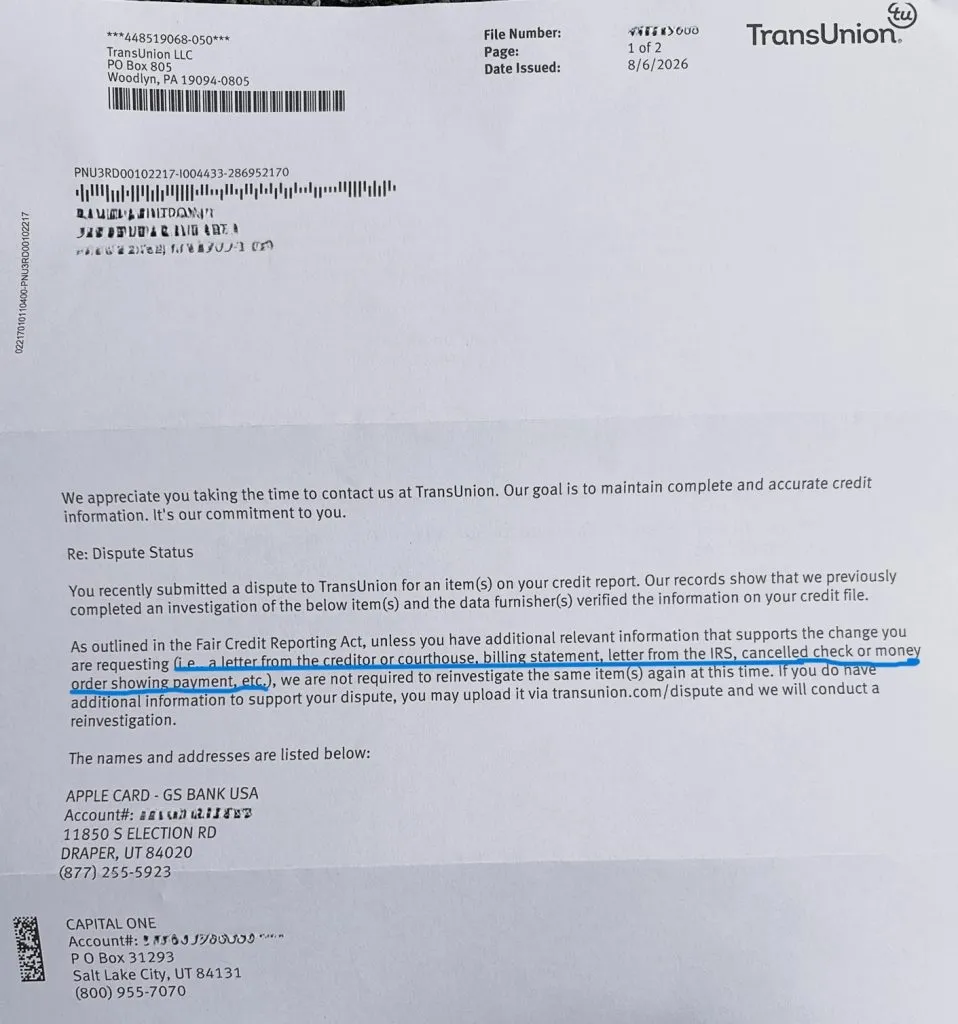
Actual TransUnion correspondence showing additional relevant information may be needed before the negative items are reinvestigated.
If you are saying something is inaccurate, the question becomes:
What new evidence do you have showing that it is inaccurate?
If the account actually belongs to you, the late payment really happened, or the collection is legitimate, you may not have new documentation proving otherwise.
That is why our primary programs go beyond simply sending disputes and instead focus on a broader compliance-based review.
Traditional dispute
“This information is inaccurate. Please investigate and correct it.”
Compliance-based challenge
“Is this information being reported, processed, investigated, and maintained in accordance with the standards and requirements that apply to it?”
That is the key difference.
A negative account can be legitimate and still warrant review of how it is currently being reported and handled.
You do not need to become an expert in Metro 2 or credit reporting procedures.
That is the work we handle.
We review your credit profile, identify the negative accounts affecting your report, prepare the appropriate challenges, review the responses, and determine the next step based on what happens.
The process is individualized to the consumer and the reporting involved.
Think of the difference this way:
A basic dispute is often a request to correct a specific fact.
Our compliance-based approach is more structured.
We prepare detailed correspondence focused on the reporting process, applicable standards, the parties involved, and the responses that follow.
It is somewhat similar to why a formal letter prepared by an attorney may receive more attention than a casual complaint.
Not because we are attorneys or because our correspondence has the legal authority of a subpoena or court order.
It does not.
The comparison is in the structure, documentation, preparation, and follow-up.
Hiring an attorney to individually review credit-reporting issues, prepare correspondence, analyze responses, and continue following up can become expensive very quickly.
Our service provides consumers with a structured, compliance-focused process at a fraction of what individualized legal representation could cost.
Tony's Credit Repair is not a law firm and does not provide legal advice or legal representation.
Every credit file is different. We do not promise specific deletions, score increases, or exact timelines. Our goal is to identify legitimate reporting and compliance issues and pursue the strongest available strategy for each client.
The short answers to what people ask most about how the 5 Points of Compliance works.
Next step
We’ll review your situation, discuss your goals, and explain which approach may make the most sense for you. Start with a Free Credit Health Check.
67 verified reviews
Pay Off Debts. Save More Money. Live Life On Your Terms.
